
 en
en
 da
da




The history of the real-estate and service company Jeudan goes back more than 120 years, and it will continue for many years to come if Finance has any say in the matter. In this article, Heidi Madsen, Deputy Director Finance, and Peter Sichelkow Meincke, Head of Finance Development, give an account of the transformation initiated by Jeudan. The goal is a thorough modernisation enabling Finance to assume the role of business partner – and one of the means to this end is solid system support. For this reason, they have implemented, i.a., the FP&A tool Workday Adaptive Planning.
Jeudan is domiciled at Bredgade 30 – in the heart of the old part of Copenhagen named Frederiksstaden, characterized by beautiful old buildings arranged like beads on a string.
The sun is shining on the cobble-stoned courtyard, and the reception area exudes life as employees and guests meet here – on their way to the coffee bar where the barista is serving cortados and americanos in a practised, kind way.
We get our coffee and move through the building’s labyrinthic, long, high-ceilinged corridors before reaching our meeting room.
Heidi Madsen and Peter Sichelkow Meincke are seated at the other side of the table. We have arranged a meeting to learn more about the transformation that Jeudan’s Finance department is undergoing.
Finance should not be held back by heavy transaction tasks
Jeudan is faced with rapid growth and offers a wide array of real-estate services across one and the same company. Contrary to other companies in the same industry, you encounter all aspects of property management in Jeudan – from investments to renovation, letting out and maintenance – which results in much task variation and provides unique insight into financial management of real-estate.
Heidi says that she has been with Jeudan for two years, and that she is part of the generational management change in Finance. A generational change that has resulted in modernisation of the entire financial organisation. It has involved a movement away from a traditional, accounting-focused Finance function towards a more proactive role as a trusted sparring partner to the business.
“Jeudan has expanded rather drastically over a relatively short period of time. And therefore it is important for us to ensure that the economy is prepared to support both a larger organisation and continued growth. Consequently, we have focused on getting new competences on board in Finance and on giving them good conditions for creating value for the business,” Heidi says and continues:
“Therefore, it is decisive for us to optimise our processes and create a solid basis for system support. Previously, much time was spent procuring the figures – but not quite as much using them. And we need to change that. We need to release time in Finance for customer and business-oriented analyses.”
The business is eager to make use of the analytical competences available in Finance. But, until now, they have lacked the system support needed to prepare such analyses – without it taking several weeks.
“Actually, we don’t have the time necessary to make very many analyses because of the number of man hours needed to do so – so data transparency is important. Jeudan is a listed company and also needs analyses to prepare the accounts. We identified a clear potential for optimising the processes related to the publication of our accounts, thereby releasing time,” Heidi explains and adds:
“The purpose is to become business partners – also to be able to attract good, ambitious employees since we have become a far more extrovert function with lots of interesting tasks.”
“It is decisive for our employees that their processes are effective, and that they believe that they create value. This is also an important reason why we are focused on gaining control of our system support, processes and data – that we want to be able to attract and retain Finance employees capable of helping to drive the business in the right direction.”
“The purpose is to become business partners – also to be able to attract good, ambitious employees since we have become a far more extrovert function with lots of interesting tasks.”
Goodbye to heavy processes
Peter nods smilingly and starts talking. He has been part of Jeudan since the turn of the year and says that he came to a Finance department that was – and still is – undergoing transformation.
“Finance has 30 employees and is still characterised by rather heavy transactions. But there is a strong will to support the rest of Jeudan’s business as finance business partners; it is a balancing act to open the door to finance business partnering in a controlled manner. We need to know how to spend our time creating as much value as possible so that we reach a point where the systems manage some of the tasks previously taking up many hours. Because we experience a huge demand for our analyses from the business – they really do want us,” says Peter.
Heidi adds that, therefore, they have also started building a finance data warehouse. So far with data from one of Jeudan’s ERP systems; getting data from the company’s other ERP system is also on the to-do list: “We would really be strengthened if that task is completed. If all our data are available there, there will be one truth,” Heidi explains.
From complicated Excel models to Adra and Workday Adaptive Planning
Jeudan uses two ERP systems: Dynamics NAV and Unik Bolig – and data from the latter have been moved to the financial data warehouse. Unik Bolig is the company’s real-estate system and the system used to, i.a., collect rent. Furthermore, Jeudan’s project and service company uses Dynamics NAV.
“So, we have two ERP systems, but previously the analysis and planning tasks were made in Excel. An abundance of Excel spreadsheets and Excel models. Originally developed by us and very difficult to take over, thereby presenting a considerable risk of errors,” says Heidi.
She stresses that, for this reason, it has been central to get transparent and intuitive system support through ‘drill-down’: “You must be able to start at the top and work your way down into things. That is necessary if we are to be able to support our management and business properly.”
Therefore, Jeudan chose us for the implementation of Adra Task Manager as one of the very first things to create an overview of Finance’s core tasks and ensure that they were solved. “It was fundamental to get an overview of the annual wheel, timelines etc.,” Peter explains and adds:
“We soon realised that we needed something on the entire financial platform as regards budgets and consolidation – to get us away from our many previous processes.”
Peter explains that he has been tasked with finding out where to start, taking into consideration where a change of processes and systems would have the greatest impact.
“A Financial Planning & Analytics (FP&A) tool was the most obvious place to get started. We had a new team, had inherited the existing budgeting and valuation process comprising 700 complex Excel files and models, and were to choose whether to delve into these or whether to implement an FP&A tool. It was decisive to make the organisation future-proof and to create a better basis for knowledge sharing and, therefore, the choice wasn’t hard to make.”
User friendliness and transparency decided the outcome
Asked what was important for the choice of an FP&A tool, Heidi replied that one of the most basic requirements was the system’s ability to handle the budgeting as well as the consolidation part. Previously, they had examined an isolated consolidation system that was relatively simple, but that would still involve quite a few manual work processes.
“But we have onboarded many new employees during the recent year, and this really opened our eyes to the complexity of our previous budgeting process. This meant that it became, more or less, our first priority to get something that also supported the budgeting process.”
“Then, the process began comparing various systems and assessing their related advantages and disadvantages.” According to Peter, Workday Adaptive Planning (Adaptive) was chosen because of its intuitiveness. “That was decisive because the budgets are to live throughout the business, where non-finance people must be able to navigate the FP&A system. And in this respect, Workday Adaptive Planning is extremely user friendly,” Peter says and continues:
“Of course, Finance can work with their figures in several systems, but others must be able to use it as well. It contained an easy user interface, and it is a well-tested tool, in which we had confidence.”
Heidi adds that it was also important to prepare the organisation for the future by choosing a system making it possible to grow in either direction.
Furthermore, Workday Adaptive Planning’s standard system met Jeudan’s needs in many respects, whereas some of the other systems being examined needed more adjustments. And that was an important point:
“We come from something that it is very complex and time-consuming to become familiar with so we have become very aware that it is easier to get support for a standard system. It is also easier for us to operate a standard system subsequently – just as it is easier to introduce new employees to a standard system,” Heidi says.
Finally, it was crucial that Workday Adaptive Planning was transparent:
"If it's a manager who prefers to see things more aggregated, they can do that – but you can also give the specialist insight into the smallest details. The system facilitates both types of 'customers', and it's an enormous strength of Workday that you get both the overview and can dive into the details," explains Peter, adding that it was also important that the system could be integrated with the ERP systems, so they can always trace back to the source.
"There's great reassurance in knowing that we can rely on what's in Workday Adaptive Planning being correct. We're going to use the tool in both the budgeting and consolidation process, so this is both a 'live' year and a learning year. We will both gain our first experience from operations and get a sense of what we can use Workday Adaptive Planning for going forward – and how we get the most out of the tool. But it also needs to settle into Jeudan. It's a bit like getting the keys to a new car, where you need to get to know the clutch point and work out how much you need to press the accelerator for it to speed up."
Next up: Easy access to key figures and dashboards
Having the consolidation and budgeting system in place means that the finance department can perform fast close on the financial reporting, and that they have streamlined the budget monitoring. This frees up time to tackle the next point on the transformation agenda: to scrutinise the financial data in their data warehouse.
"This means that we can get started in terms of determining what reporting and what analyses we should prepare on an ongoing basis for the different business areas. Furthermore, there's a task in working out how we ensure that our managers have easy access to key figures and dashboards, so they have the management tools they need," explains Heidi.
In addition, it's on the to-do list to get Jeudan's Dynamics NAV data into the financial data warehouse and to link business data with the financial data with regard to taking on the role of business partner. But Heidi emphasises that one of their most important priorities is to better equip the managers of the different business areas to make informed decisions:
"It's very important for us to make these dashboards available to our managers, so they have easy access to their key figures and management parameters and can continuously see how they are developing. It's simply not good enough if our management has to sit and wait to find out where the business is heading. So it's very important for us to make this available," concludes Heidi.
Full circle consultancy
When helping you digitalise and automate a Finance function, we combine applications and tools that meet your particular needs. With a solution that complements the data, processes, and people working hard behind the lines in the best possible way.
Therefore, Finance IT Services is a team with a solid understanding of accounting processes and financial management as well as with digital competences.
The illustration below shows Finance IT Services’ digitalisation circle, consisting of the competences that we can bring into play when digitalising your company’s financial processes – with a holistic point of departure.
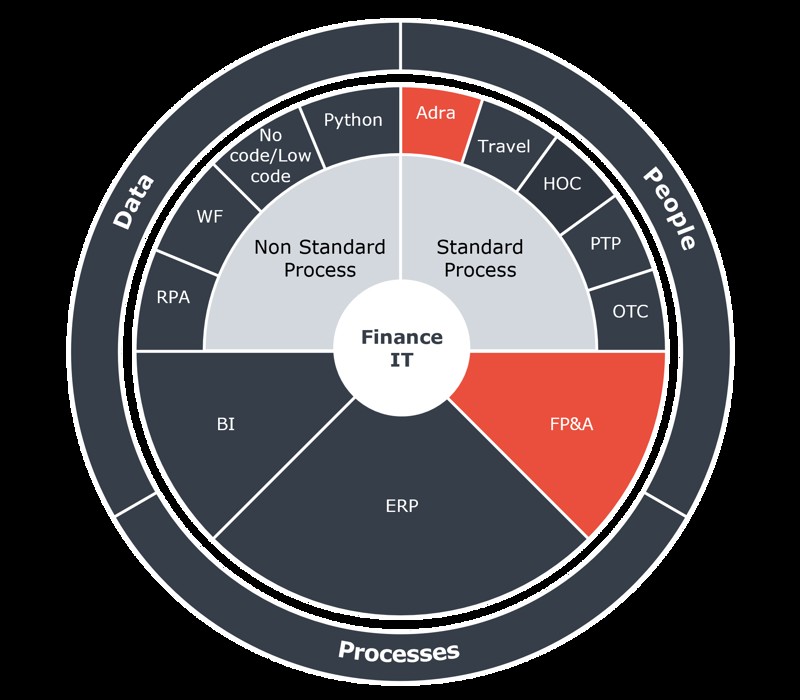
Finance IT Services’ digitalisation circle

Do you need sparring for your planning process?
We at Basico have many years’ experience with dynamic planning, and we are pleased to be able to support our consultancy with a system that it is easy to implement and the functionality of which is of a high quality.
Please contact Partner Morten Boldsen if you would like to know more about what we can do for your company.